
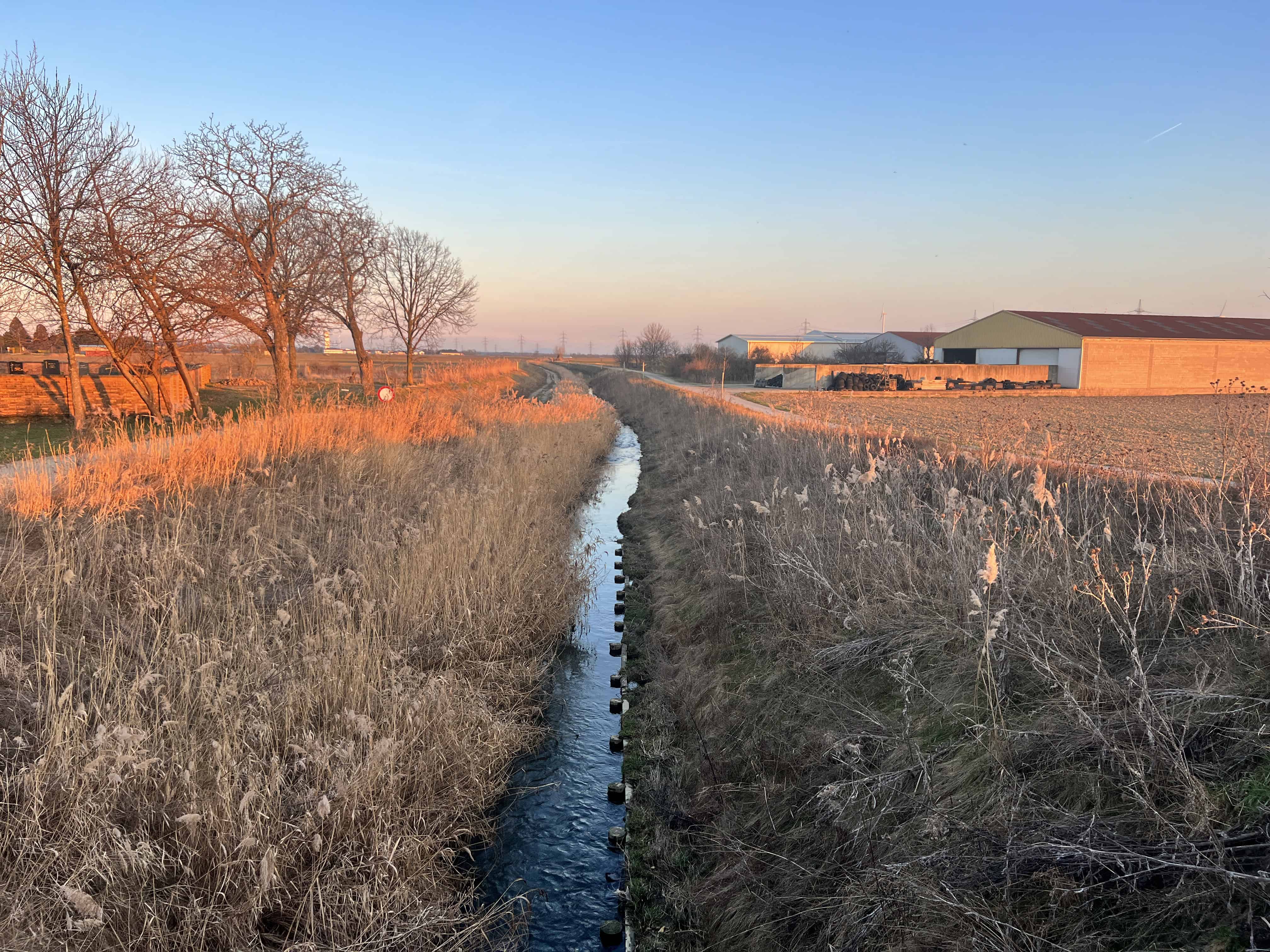
In the beginning of March ALFAwetlands team of the European Wilderness Society visited the Russbach region near Deutsch-Wagram in the Marchfeld plain (Lower Austria), together with representatives from LIFE AMooRe and local stakeholders and decisions makers. The field visit provided an on-the-ground view of how historical drainage and river engineering reshaped the landscape and how current restoration measures are working to improve water retention, habitat quality, and resilience.
From “drain the land” to “make room for water”
Like many lowland regions in Central Europe, the Marchfeld historically contained more wet meadows, floodplains, and seasonally inundated areas. Over time, the dominant water-management approach shifted toward rapid drainage: wetlands were drained, channels were straightened, and streams were regulated to support intensive land use.
The Russbach is a clear example of this shift. By the mid-19th century, the stream had increasingly been regulated and straightened to accelerate runoff and reduce waterlogging, an approach typical of the era that shaped the river corridor for generations.
The 20th century: a new challenge emerges
While drainage and regulation addressed some short-term concerns, they also contributed to long-term effects: simplified habitats, reduced natural retention, and altered groundwater dynamics. Across the wider Marchfeld, land-use pressures and water management coincided with declining groundwater levels, making water scarcity an increasing concern in some areas.
A turning point since 1992: bringing water back via the Marchfeld Canal
A major shift occurred with the Marchfeld Canal system, which went into operation in 1992. Since then, the Russbach has been supplied (“doted”) with Danube water via this system, helping to stabilise flow conditions and contributing to a rise in groundwater levels in parts of the Marchfeld.
For wetland and river restoration, this is highly relevant: reliable water availability is a key foundation for healthier riparian ecosystems and connected wetland habitats.
Restoration in action: giving the Russbach more room (since 2023)
A central focus of the visit was the progress of ongoing revitalisation measures, particularly in the section between Pillichsdorf and Großengersdorf, where works aim to improve both ecological quality and flood resilience.
Key steps include moving embankments outward and widening the river corridor, giving the Russbach more space during high flows while creating more diverse habitats. The project includes major earthworks and subsequent phases such as installing in-stream structures (e.g., natural woody elements) and extensive planting to re-establish riparian vegetation.
Nature restoration and local recreation: a wetland with year-round potential
Beyond biodiversity and water management, the Russbach corridor is also an important nearby recreation area, especially around Großengersdorf. Partners and local stakeholders highlighted that this recreational potential is not fully usable throughout the year, despite the area’s value as green space close to settlements.
Stakeholders also described a local land-use timeline in which a long-established white-tailed eagle pair was present in the area for several years during which nearby wind turbine construction did not move forward. After the pair was no longer observed, the previously delayed turbines were erected within a relatively short period.
In winter, parts of the area are reportedly avoided or temporarily restricted due to safety considerations related to nearby wind turbines, specifically the risk of ice throw (falling or projected ice fragments) during freezing conditions. In addition, during the hunting season, access and quiet recreation can be limited, reducing the time window for walking, nature observation, and environmental education.
A circular trail around a retention wetland
A particularly notable feature is a wetland/pond biotope encircled by an approximately 4.2 km loop trail. From a hydrological perspective, the wetland functions as a multi-stage retention system (with several “levels” or basins). Field discussions indicated that, when soils are not already saturated, the system can buffer prolonged rainfall events, absorbing roughly up to two weeks of rain before overflow becomes likely. This type of retention capacity is exactly what restoration aims to protect and strengthen: slowing water down, reducing peak runoff, and keeping moisture in the landscape longer.
Improving connectivity for wildlife: fish passability
Wetlands are not only about water quantity, connectivity is equally important. In 2023, measures were implemented to make the Russbach connection to the Marchfeld Canal system passable for fish, supporting ecological continuity along the water network.
Why this matters: learning from floods, building resilience
Recent high-water events have underlined why retention space matters. Reports from 2024 describe breaches and emergency responses along the Russbach system, highlighting the vulnerability of narrow, heavily embanked channels under extreme conditions.
Restoration does not “eliminate” floods, but widening corridors, reconnecting floodplain functions where possible, and designing for retention can reduce peak pressure, slow runoff, and create landscapes that cope better with extremes. For ALFAwetlands, this is a core message: healthy wetland systems are nature-based infrastructure.

ALFAwetlands: connecting partners through field exchange
During the joint field trip, the European Wilderness Society team, LIFE AMOORE representatives, and stakeholders discussed how local restoration measures link to broader wetland objectives: improving habitat quality, supporting biodiversity, strengthening climate adaptation, and demonstrating approaches that can be shared across regions.
The Russbach region illustrates how quickly landscapes can be transformed and how, with the right tools and partnerships, they can be transformed again: from drainage to regeneration, from narrow channels to living river corridors, and from short-term fixes to long-term resilience.
We thank our partners and local stakeholders for the exchange and insights. We will continue to share findings from ALFAwetlands field activities and highlight practical examples of wetland restoration across Europe.