
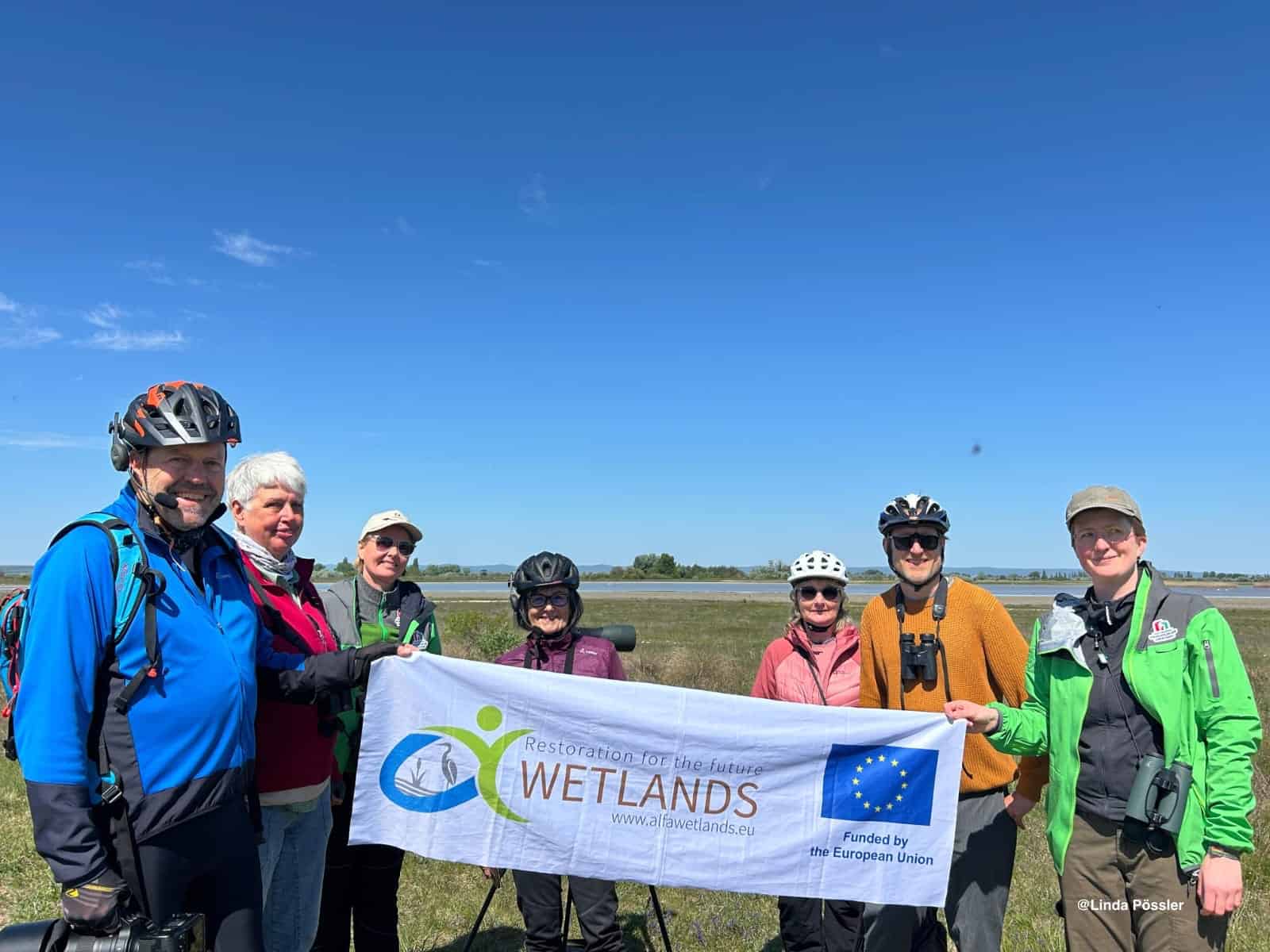
From 23 to 27 April 2026, citizen engagement returned to the Austrian-Hungarian Living Lab within the ALFAwetlands project. The City Nature Challenge 2026 and the Living Lab Open Day invited citizens, families, researchers and protected area representatives to document biodiversity of international importance and to explore the results and activities of ALFAwetlands. The focus was on the uniqueness of the Austrian-Hungarian Living Lab, as well as on its challenges, solutions and citizens input.
There was also a chance to get a deeper look into ALFAwetlands Living Labs across Europe and the variety of the project wetlands.
Many events in one place
The Illmitz Information Centre in the Neusiedler See – Seewinkel National Park (National Park) once again hosted a vibrant programme, including BirdExperience 2026 (up to 4000 participants and visitors). Together with the City Nature Challenge, Long Night of Research (up to 500 visitors) and the ALFAwetlands Living Lab Open Day on 24 April, the event combined citizen science, hands-on outdoor activities, public engagement and cross-border cooperation.
Visitors discovered the ALFAwetlands Living Labs through a photo exhibition and additional explanations provided by representatives of the European Wilderness Society and the National Park. The exhibition helped participants better understand the different Living Labs, their landscapes, restoration approaches and role in the wider ALFAwetlands project.
Also another ALFAwetlands partner from Austria – International Institute for Applied System Analysis(IIASA) joined the event and explained their research work, including importance of biodiversity observations for their work.

What is Austrian-Hungarian Living Lab?
Austrian-Hungarian Living Lab includes reed belt of the lake Neusiedl on Austrian and Hungarian sides. Among the challenges of this Living Lab are: economic use, management and nature conservation, climate change: reed belt dieback, production and emission of methane, water level fluctuations, tourism pressure. Particularly, reed cutting partially restricted and concentrated on peripheral areas due to warmer winters.
Restoration efforts include mowing and grazing of reed edge areas, testing fire management as a potential tool, and comparing different areas to evaluate effectiveness.
Stakeholders are involved in a fire management experiment with the aim of adapting the legal framework accordingly. If successful, the fire management legislation can be changed.
A common understanding among stakeholders of the best possible wetland management method will be reached. In addition, this Living Lab includes a lot citizen engagement activities and awareness raising events, which can be a good example for other Living Labs and study areas.

Open Day features
Participants were also introduced to ALFAwetlands citizens and landowners questionnaire surveys and their findings. These discussions helped to connect scientific work with local perspectives and gave visitors the opportunity to reflect on wetlands, biodiversity, restoration measures and the role of people in protecting these ecosystems.
We live in the Neusiedl area and value it, but now it is also great to know, that our lake is part of international wetland research,
states local citizen
Children also took part actively in the programme. They joined a quiz, answered questions about wetlands and biodiversity, and won useful prizes. These activities helped make the topic accessible for younger visitors and encouraged families to learn more about wetland ecosystems together, as well as to contribute to the necessary biodiversity monitoring activities.

City Nature Challenge 2026
A key highlight was the City Nature Challenge, which took place in the region for the sixth time and expanded across Austria and Hungary. Participants recorded wild animals, plants, fungi and other organisms in the Neusiedler See – Seewinkel area and surrounding regions often using iNaturalist. So far we have more than 3200 observations of 1020+ species, with the lead of European tree frog, Ruff, greylag goose.
To support biodiversity observation on the regular basis, bilingual inclusive signs were installed at the National Parks territories in Austria and Hungary at the biodiversity observation places. The observations made through iNaturalist contributed to a wider citizen-science effort to make local biodiversity visible. Participants uploaded photos, while other users and experts helped with species identification.The upload and identification phase is scheduled to continue after the observation days, helping to improve the quality of the data and supporting its later use for biodiversity research, protected area management and conservation, contributing also to ALFAwetlands research.
Citizen observations are incredibly valuable for research. They help us collect much more data than scientists could gather on their own. This kind of data gives us a better picture of biodiversity in our wetlands...
says Dmitry Shchepashchenko from International Institute for Applied Systems Analysis (IIASA), ALFAwetlands partner.
The activities also encouraged participants to look more closely at common and less visible species, to recognise the biodiversity around them, and to understand how individual observations could contribute to a larger scientific picture.
A cross-border bike excursion also took place on 27 April and led participants through meadows, pastures and salt flats in the heart of two national parks in Austria and Hungary. It created further opportunities to combine outdoor experience, species observations and cross-border exchange.

BirdExperience and further synergies
Alongside the City Nature Challenge and the Living Lab Open Day, BirdExperience offered guided excursions, workshops, expert talks, BirdRace and BirdQuiz activities, and insights into bird ringing. The overlap of these events created many synergies between birdwatchers, citizen scientists, families, researchers, conservation experts and Living Lab stakeholders.
These synergies strengthened the visibility of ALFAwetlands activities and connected the project with ongoing local and international initiatives. They also helped link biodiversity monitoring, public awareness, wetland restoration, environmental education and protected area management in one shared programme.

Citizen engagement in action
The ALFAwetlands Austrian-Hungarian Living Lab served as a space where researchers, protected area managers and citizens collaborated on wetland biodiversity and restoration-related questions. Through biodiversity observations, public discussions, questionnaire surveys and direct exchange, visitors became active contributors to the Living Lab process.
Together, the City Nature Challenge, the Living Lab Open Day created a hands-on experience for different audiences, from experts to families. The events encouraged people not only to observe nature, but also to contribute to biodiversity knowledge, share their views and engage with the future of wetlands across borders.
This is an excellent example of engaging citizens of all ages in wetland awareness activities and serves as a model that can be replicated elsewhere,
admits Iryna Shchoka, Living Lab Open Day co-organiser from European Wilderness Society.